ICSE Class 10 Force, Turning Effects of Force, and Uniform Circular Motion — Mock Test (2027)
Free online mock test for Force, Turning Effects of Force, and Uniform Circular Motion (ICSE Class 10 Physics) — 20 competency-based questions based on the latest CISCE 2027 syllabus, with instant marking. Try the samples below, then take the full test free.
What to expect: This mock test covers key concepts from the Force, Turning Effects of Force, and Uniform Circular Motion chapter — including application-based and competency-focused questions aligned with how ICSE actually sets the paper.
Tip: Attempt without notes first to identify gaps, then review explanations for any wrong answers. Retake after a few days for best retention.
Sample questions
-
1.Why does skidding usually occur on a rainy day along a curved path?
- A.The road becomes smoother, increasing friction.
- B.The force of friction decreases, failing to provide necessary centripetal force.
- C.The vehicle's tires become more adhesive to the road.
- D.The centripetal force required becomes zero on a rainy day.
-
2.Fig. 1.32 shows a uniform metre rule placed on a fulcrum at its mid-point O and having a weight $40\mathrm{gf}$ at the $10\mathrm{cm}$ mark and a weight of $20\mathrm{gf}$ at the $90\mathrm{cm}$ mark. (i) Is the metre rule in equilibrium? If not, how will the rule turn? (ii) How can the rule be brought in equilibrium by using an additional weight of 40 gf?

-
3.Why are racing cars designed to be very broad and very low in height?
- A.To increase the centre of gravity for better aerodynamics
- B.To keep the centre of gravity very low, ensuring stability during sharp turns at high speeds
- C.To reduce the weight of the car for higher speeds
- D.To allow for larger fuel tanks and more power
-
4.The moment of a force of 5 N about a point P is 2 Nm. Calculate the distance of point of application of the force from the point P.
-
5.A uniform metre scale rests horizontally on a knife edge at the 60 cm mark when a mass of 10 g is suspended from one end.
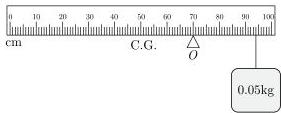 From which end should this mass be suspended, and what is the mass of the metre scale?
- A.From the 100 cm end; mass of metre scale is 40 g
- B.From the 0 cm end; mass of metre scale is 40 g
- C.From the 100 cm end; mass of metre scale is 20 g
- D.From the 0 cm end; mass of metre scale is 20 g
Ready? Take the full 20-question test free — instant marking, no sign-up needed.
▶ Start free mock test