ICSE Class 10 Sound — Mock Test (2027)
Free online mock test for Sound (ICSE Class 10 Physics) — 20 competency-based questions based on the latest CISCE 2027 syllabus, with instant marking. Try the samples below, then take the full test free.
What to expect: This mock test covers key concepts from the Sound chapter — including application-based and competency-focused questions aligned with how ICSE actually sets the paper.
Tip: Attempt without notes first to identify gaps, then review explanations for any wrong answers. Retake after a few days for best retention.
Sample questions
-
1.A radar is able to detect the reflected waves from an enemy aeroplane after a time interval of 0.02 millisecond. If the velocity of the waves is $3 \times 10^{8} \mathrm{ms^{-1}}$, calculate the distance of the plane from the radar.
-
2.Which property of waves is essential for their use in echo depth sounding?
- A.Waves must be visible to the human eye.
- B.Waves must travel undeviated over long distances and form a narrow beam.
- C.Waves must have a frequency below 20 Hz.
- D.Waves must be absorbed quickly by the medium.
-
3.What property of a musical note allows us to distinguish between two notes of the same pitch and intensity produced by different instruments, as illustrated in the diagram?
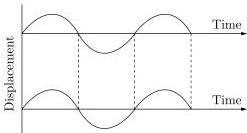
- A.Amplitude
- B.Frequency
- C.Quality or Timbre
- D.Wavelength
-
4.How is a sound wave produced in a string that is fixed at both ends?
- A.By generating longitudinal waves directly in the string that travel to the ear.
- B.By creating transverse vibrations that reflect at fixed ends, forming standing waves which produce longitudinal waves in air.
- C.By striking the string to produce only transverse waves that reach the ear directly.
- D.By plucking the string to create sound waves that do not reflect at the ends.
-
5.What do the terms (1) amplitude and (2) frequency of a wave refer to?
- A.(1) Distance between two crests; (2) Time taken for one vibration.
- B.(1) Maximum displacement from mean position; (2) Number of vibrations per second.
- C.(1) Speed of the wave; (2) Wavelength of the wave.
- D.(1) Height of the wave; (2) Energy carried by the wave.
Ready? Take the full 20-question test free — instant marking, no sign-up needed.
▶ Start free mock test